

What Makes a Property Remain Desirable 10 or 20 Years From Now?
When I evaluate a property, one of the first questions I ask is not what it is worth today.
I ask what could make people want it 10 or 20 years from now.
That distinction changes the way I look at real estate.
Today’s price tells me where the property sits in the market at a specific moment. It does not necessarily tell me how the property will perform through changing buyer preferences, new construction, shifts in inventory, infrastructure changes, or different economic cycles.
For a long-term analysis, I want to understand the market surrounding the property first.
Location. Scarcity. Infrastructure. Construction quality. Privacy. Accessibility. Demand.
None of these factors can predict the future on its own. Together, however, they can help explain why certain properties maintain relevance while others become less competitive over time.
Why long-term value starts with the market
Real estate is an asset that cannot be separated from its surroundings.
A property can be beautifully designed, recently renovated, or positioned at an attractive price, but its long-term desirability is also connected to what happens outside its walls.
What is being built nearby?
How much land remains available?
How easy is it to access the area?
What types of buyers are looking there?
Is the neighborhood becoming more or less difficult to enter?
How much comparable inventory exists?
These questions can be more revealing than looking at a property's current asking price alone.
This is particularly important in Miami, where different neighborhoods can have very different characteristics despite being relatively close to one another.
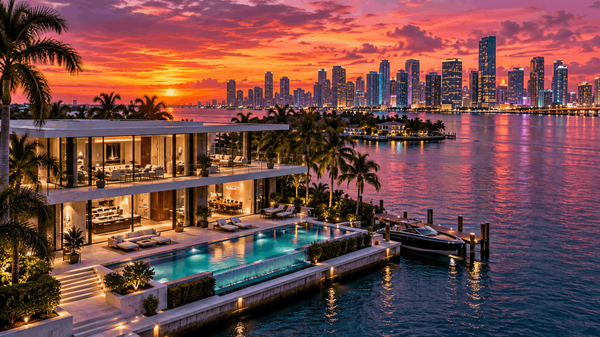
A waterfront property, for example, has a fundamentally different relationship with land scarcity than a property in an area where new residential development can continue expanding.
That does not automatically make one property a better investment than another. It means the underlying market dynamics are different and should be analyzed accordingly.
The factors that can support lasting demand
When I think about long-term desirability, I look at several structural characteristics.
Location
Location remains one of the most difficult characteristics to replicate.
A property may be renovated, expanded, or redesigned. Its exact position, however, cannot be changed.
Proximity to the water, established neighborhoods, commercial districts, transportation, cultural destinations, and other amenities can influence how a location is perceived by future buyers.
But location is not simply about being close to something desirable today.
I also consider how the surrounding area is likely to evolve.
Scarcity
Scarcity is another important factor.
If a particular type of property is difficult to reproduce because of limited land, zoning, geography, or neighborhood characteristics, its competitive environment can be different from a market where comparable properties can be added more easily.
This is one reason I pay close attention to inventory.
A limited number of comparable properties does not guarantee future appreciation. It does, however, change the supply side of the market and can influence how buyers compete for properties with specific characteristics.
Infrastructure and accessibility
A desirable location also needs to remain connected.
Transportation improvements, access to major employment centers, airports, commercial areas, schools, cultural destinations, and other parts of the region can influence how practical a location remains over time.
Infrastructure is particularly relevant in a growing metropolitan area like Miami.
The city continues to evolve, and changes in transportation and development can alter how different neighborhoods connect to the rest of the region.
Construction quality and property characteristics
The physical property matters as well.
Construction quality, layout, materials, maintenance requirements, outdoor space, views, privacy, and adaptability can all affect how a property competes with newer alternatives.
A property does not necessarily need to be new to remain desirable.
In many cases, the combination of an established location and strong underlying property characteristics can be difficult for new construction to replicate.
Privacy and lifestyle
Lifestyle is also an important part of Miami's high-end residential market.
According to Corcoran's second-quarter 2026 Miami Beaches and Coastal Mainland market report, buyers continue to prioritize space, privacy, and lifestyle, while single-family inventory remains constrained. Corcoran reported that Miami Beaches single-family inventory was down 24% year over year and Coastal Mainland single-family inventory was down 22% at the end of the quarter.
These preferences are not necessarily temporary market trends.
For many buyers, privacy, outdoor space, proximity to the water, and the ability to enjoy a particular lifestyle are part of the reason they choose a property in the first place.
That can matter when considering how a property may remain relevant as buyer preferences evolve.
What Miami’s current market tells us
Miami's recent market activity provides a useful example of why these factors deserve attention.
Corcoran's second-quarter 2026 report described continued strength in Miami's luxury market and noted that shrinking single-family inventory was keeping competition elevated. Miami Beaches single-family sales increased 37% year over year, while Coastal Mainland single-family sales increased 29%.
The numbers also varied considerably by market.
On the Miami Beaches, the median single-family sale price increased 77% year over year to $4.9 million, while the Coastal Mainland median reached $2.29 million, up 15%.
These figures should not be interpreted as a forecast for individual properties.
They illustrate something more useful: buyers are not responding to every part of Miami in exactly the same way.
The characteristics of the location and property type matter.
That is why I prefer to look at the structural factors behind the numbers rather than simply focusing on whether a particular median price increased or declined.
If inventory is limited in a neighborhood where buyers continue to value a specific type of property, that creates a different market environment from one where comparable properties can be added quickly.
Why Coconut Grove and Coral Gables deserve attention
Coconut Grove and Coral Gables are good examples of why neighborhood-level analysis matters.
Both areas have established identities and characteristics that distinguish them from Miami's denser high-rise markets.
Coconut Grove, for example, combines proximity to Biscayne Bay with an established residential environment and relatively limited opportunities to recreate the same combination of location, greenery, and neighborhood character elsewhere.
Coral Gables has a different profile, with established residential streets, distinctive architecture, mature landscaping, and proximity to employment, commercial, and cultural destinations.
Corcoran's first-quarter 2026 Miami market report specifically identified Coral Gables and Coconut Grove as areas driving outsized gains in the Coastal Mainland's luxury market, noting that high-end buyers were increasingly active across mainland submarkets.
That does not mean every property in either neighborhood will maintain the same level of demand.
It means these neighborhoods demonstrate why I look beyond the individual property.
A property's long-term appeal can be influenced by characteristics that are difficult to reproduce: established location, limited comparable inventory, proximity to the water, neighborhood identity, and the broader lifestyle associated with the area.
Those factors can continue to matter even as architectural preferences, financing conditions, and buyer priorities change.
Conclusion
What makes a property remain desirable 10 or 20 years from now?
There is no single answer.
Location, scarcity, infrastructure, construction quality, privacy, accessibility, and demand can all contribute to long-term relevance. But their importance depends on the specific market and property being evaluated.
Miami's current market demonstrates this clearly. Corcoran's recent reports show continued demand for luxury and single-family properties, alongside declining inventory in several segments and strong activity in markets such as Coral Gables and Coconut Grove.
For me, that reinforces a principle I use when analyzing real estate: the property is only part of the equation.
Before I look at the finishes, the floor plan, or even the current asking price, I want to understand the market around it.
Because a property's long-term potential does not begin with the property itself.
It begins with the location, the supply, the infrastructure, the buyer demand, and the characteristics of the market that surrounds it.
As Isaac de Castro at Brown Harris Stevens, that is the perspective I bring to long-term real estate analysis: understand what makes a property relevant today, but also examine what could make it remain relevant as the market changes.
Categories
Recent Posts






GET MORE INFORMATION
